AI Splits Tax Roles, People Still Lead
Welcome to The Oxford Tax Recruiting Brief, your monthly read on where the tax job market is actually moving.
Each issue breaks down current hiring patterns, firm developments, and compensation trends across public accounting and corporate tax teams. You’ll find concise analysis, real job opportunities, and straightforward insight from recruiters who work these searches every day.
Here’s what we have for you this month:
- AI Redefines, Not Replaces, the Tax Profession
- PwC Rebuilds, OpenAI Expands, and AICPA Sounds the Alarm
Let’s get into this month’s market.
The Entire AI isn’t taking tax jobs; it’s splitting them in half.
The panic around automation misses what’s actually happening inside tax departments: tools are absorbing the repetitive work, and the roles left behind look nothing like they used to.
Walk into a tax department today, and you’ll see two kinds of professionals emerging. The first still does compliance, but faster, software flags errors, pulls data, and drafts returns while they review, approve, and handle exceptions. The second barely touches a return at all. They’re building models, advising on structure, sitting in strategy meetings, and translating tax implications for executives who don’t speak IRC.
The work didn’t disappear. It separated.
Routine tasks like data entry, basic calculations, and standard filings are moving to platforms that don’t sleep or miss deadlines. What’s left requires judgment: interpreting new guidance, navigating audits, weighing risk in M&A, and designing incentive structures that survive scrutiny. These aren’t jobs a chatbot can do. They’re jobs that need a tax professional who can think three steps ahead and explain it to someone who can’t.
What this means for hiring:
- Junior roles are shrinking, but not vanishing. Firms and companies still need people who can learn the fundamentals, but the path to senior roles is faster and steeper than it used to be.
- Mid-level jobs are splitting. Some lean technical (systems, data integrity, automation oversight). Others lean advisory (planning, controversy, cross-functional collaboration). Candidates need to pick a lane.
- Senior hires need a range. The best tax leaders today aren’t just technical experts; they’re translators, strategists, and operators who can work across finance, legal, and the C-suite.
If your team feels understaffed but you’re not sure what role to post, that’s the signal. The job you need might not be the job you had five years ago.
AI is rewriting the tax function, but it’s not writing people out of it. The firms and companies that adapt fastest are the ones building teams around what humans do best: judgment, strategy, and the ability to make a call when the code goes quiet. If you’re rethinking what your next tax hire should look like, or what your next move should be, explore our current open positions and see where the market’s headed.
News Pulse

PwC is restructuring its U.S. advisory business into eight specialized divisions and hiring thousands of professionals, reflecting renewed confidence in consulting demand after prior cuts.
OpenAI takes a stake in Thrive Holdings to embed AI into accounting and IT services, combining research expertise with industry operations to automate complex business processes.
AICPA and state CPA societies urge the Department of Education to classify accounting as a “professional degree program,” warning that exclusion could restrict student loan access and weaken the CPA pipeline.
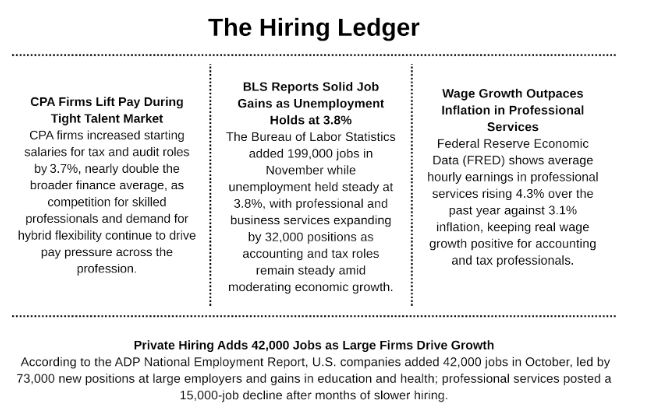
ADP reports 42,000 private-sector jobs added in October, with gains in education and health care and in trade, transportation, and utilities, while professional services, information, and leisure and hospitality lost ground.
PwC seeks hundreds of technologists to support AI-driven client work, but its global chairman says the firm is struggling to find qualified candidates as it shifts away from traditional graduate hiring.
Top consultancies are freezing starting salaries as AI reshapes the traditional “pyramid” model, signaling a slowdown in entry-level hiring across major firms.
Job Board
- Tax Manager (Wealth Management Firm) – Denver (Hybrid), $125K–$175K + Bonus Lead a boutique tax advisory team partnered with a sister wealth management firm, serving high-net-worth clients through integrated planning without the public-accounting grind.
- Tax Manager (Boulder CPA Firm) – Boulder (Hybrid), $130K–$170K Join a collaborative CPA firm known for mentorship, accountability, and client success, leading complex compliance and planning engagements across diverse entities.
- Senior Tax Advisor – Wealth Management – Denver (Hybrid), $125K–$175K + Bonus Direct-hire position focused on federal, state, and international compliance, ASC 740 analysis, and audit support for a wealth management group with international exposure.
- Senior Tax Analyst (Investment Capital) – Denver (Hybrid), $90K–$110K Join a five-person tax team at an investment firm, managing partnership and S-corp returns, mentoring staff, and driving strategic planning for high-net-worth clients.
Click here for a complete listing of our jobs.
Every issue of this newsletter shows the same pattern: tax hiring hasn’t stopped, it’s just shifted. The firms that adapt are still landing strong people, while others sit in “wait and see” mode, wondering where all the candidates went.
If you’ve got a tax role that’s been open longer than expected, I can help you figure out why. We’ll review your search strategy, how your compensation stacks up, and where the right candidates are actually landing. Just reply and say “review my search.” I’ll take it from there.

Jay McCauley,
Executive Recruiter
jay.mccauley@oxfordtaxrecruiting.com
303-730-0100